

Soshinkan Leadership Training Camp 2025 Report
The Soshinkan Leadership Training Camp was held at the Soshinkan Headquarters Dojo on Awaji Island for five days, from July 17 (Thursday) to July 21 (Monday). Under the guidance of Ushiro Kancho, instructors from across Japan, along with branch chiefs from the United States and Europe, gathered for intense training.
The camp's theme was "cultivating (creating) Chushin (translated as center)." This cultivation allows for the generation of energy, the attainment of a "zero" state, and the strengthening of specific body parts. The training began with an explanation of the steps involved: five types of Uke, Ten no Kata, and throws and steps originating from strikes.
The first two days focused on breathing. Exercises included verifying techniques from Ude-Uke and performing Sanbon-Ido . The goal was for each participant to identify where they were getting stuck. Ushiro Kancho repeatedly emphasized the need for movement at a cellular level, rather than muscle movements directed by the brain. To prevent participants from compensating with their bodies when standing, which allows them to avoid confronting their cellular restrictions, some exercises were conducted lying down. This limited physical freedom, forcing participants to concentrate more on their breathing and connecting with their partners.
From the third to the fifth day, participants were divided into two groups, led by Enomoto Shihan and Takuji Shihan, respectively. Each group focused on five specific kata. Throughout these sessions, instructions on Zanshin, Shomen , and Triangle were given, always in conjunction with each participant's breathing. Ushiro Kancho likened breathing to water flowing through a garden hose, simply needing the faucet to be turned. He pointed out how shallow and frequently stopped the participants' breathing often was.
Over the five days, Ushiro Kancho stressed the importance of approaching training with short-term, medium-term, and long-term perspectives. He also discussed the pitfalls of addressing short-term goals with a long-term mindset. Enomoto Shihan also highlighted the importance of abandoning old habits and familiar movements and instead fitting into a frame. While a lack of proper frame is unacceptable, any areas that deviate from it must be corrected. The guidance emphasized that rather than simply performing repetitions, viewing Ushiro Karate with short-term, medium-term, and long-term goals means that even if things are difficult and you can't achieve something in the short term, it will lead to results in the medium term.
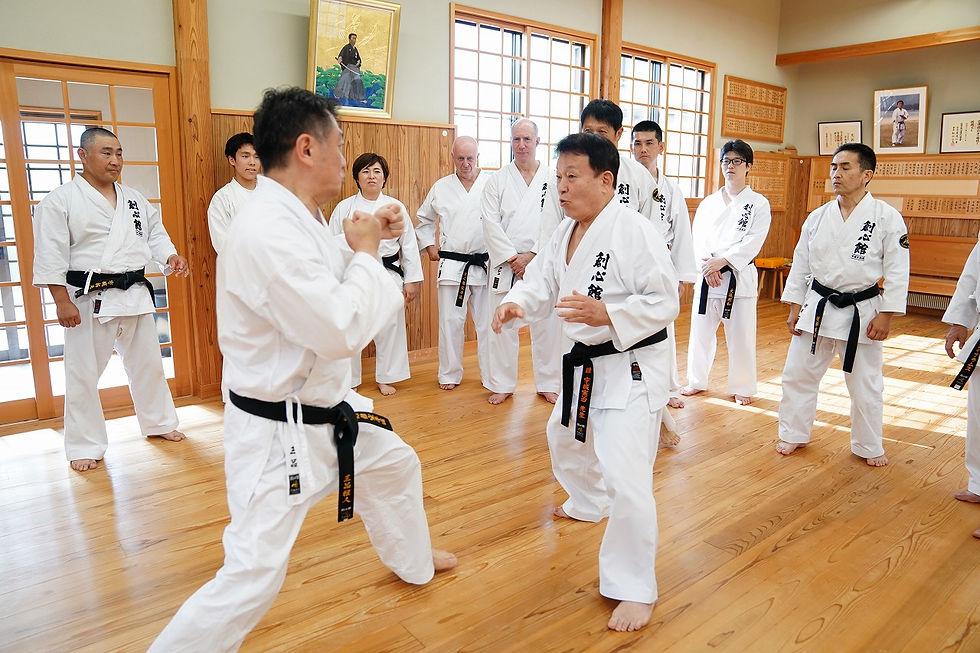

Ushiro Kancho also demonstrated through various verifications that assuming a kamae (stance) is a sign of fear. No matter how strong the mind tries to be, the body and cells already know the answer and react before the brain's commands. If you completely expose yourself, an opponent's strike will not land. However, to expose oneself fully requires a thorough confrontation with oneself. The objective is not to apply a technique to an opponent; the arrow of focus always points inward towards oneself. The training consistently allowed participants to experience this firsthand.


Ushiro Karate is a Bujutsu that seeks depth. While simple, easily replicable techniques spread quickly, the goal is not widespread popularity. Instead, it is through each student's pursuit of depth and ascent to higher levels that the base will expand as a result. This is how Ushiro Karate spreads. To achieve this, one must have absolute trust in their endeavors and generate energy to become a beacon of hope for changing the world. The four nights and five days spent in the intense time and space of the Soshinkan Headquarters Dojo became a training camp where each individual brought back learning at a cellular level.

コメント